The Seven Liberal Arts in Freemasonry
The Seven Liberal Arts represent the foundation of human knowledge and spiritual development in Freemasonry. These disciplines, rooted in ancient Greece and Rome, were preserved and transmitted through medieval Christendom, and hold profound significance in Masonic teachings. They are divided into two categories: the Trivium (the arts of language) and the Quadrivium (the arts of number and harmony).
Historical Development of the Liberal Arts
Ancient Origins: Classical Greece and Rome
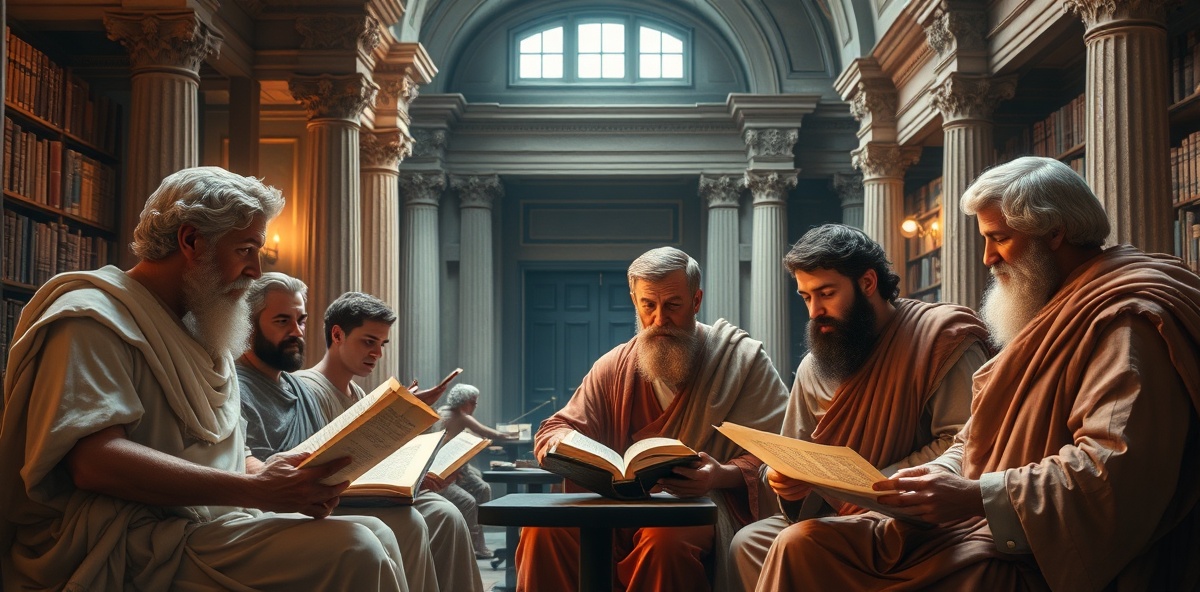
The concept of liberal arts originated in ancient Greece, where philosophers recognized that free citizens should receive education in disciplines that developed the mind and spirit, as opposed to mechanical or servile arts practiced for practical survival. The Greek word "skhole" (from which we derive "school") originally meant leisure time—the time free individuals had for intellectual pursuits. The ancient Greeks understood that true freedom required cultivation of the intellect.
Classical Greek philosophers, including Plato and Aristotle, emphasized the importance of studying mathematics, geometry, and rhetoric as paths to wisdom. However, the organized system of seven specific disciplines did not yet exist. Instead, education focused on grammar (the study of language and literature), music (including the study of harmony and proportions), gymnastics (physical development), and philosophy.
The Romans adopted and adapted Greek educational principles. Roman scholars like Cicero and Quintilian developed more formal systems of rhetoric and wrote extensively about the nature of liberal education. Roman engineers applied mathematical principles—including geometry, arithmetic, and music (harmonic proportions)—to construct their magnificent aqueducts, buildings, and bridges. This practical application of mathematical knowledge demonstrated the connection between abstract learning and tangible creation.
During the Roman period, the concept emerged that a liberal education should encompass knowledge of language, rhetoric, mathematics, and harmonics. These disciplines became recognized as essential to the education of free citizens who would engage in governance, philosophy, and the affairs of the state.
Medieval Systematization: The Formal Seven Liberal Arts
The systematic division of seven liberal arts into the Trivium and Quadrivium was formally established during the medieval period, primarily through the work of early medieval theologians and scholars. The most significant figure in this systematization was Boethius (c. 480-524 CE), a Roman philosopher and statesman who wrote comprehensive commentaries on Aristotle and developed the framework that would dominate medieval education for centuries.
Following Boethius, medieval theologians recognized that the seven liberal arts provided the perfect educational foundation. The division into Trivium (three arts of language: Grammar, Logic, and Rhetoric) and Quadrivium (four mathematical sciences: Arithmetic, Geometry, Music, and Astronomy) created a coherent system. The Trivium was understood as the gateway—one must master language and reasoning before proceeding to the higher mathematical sciences. This progression mirrored the spiritual journey from material to transcendent understanding.
Medieval monasteries and cathedral schools became the custodians of this knowledge. Monks and clerics studied these disciplines not merely as academic exercises but as paths to understanding God's creation and natural law. The cathedral schools that developed around major churches became centers of learning where the liberal arts were systematically taught. These institutions preserved classical knowledge through the turbulent period of the early medieval centuries and ensured its transmission to future generations.
The medieval period saw the creation of visual representations of the seven liberal arts, often depicted as seven maidens or symbolic figures in cathedral sculptures, manuscripts, and art. These images became powerful teaching tools, making abstract knowledge concrete and memorable. The liberal arts were often shown in hierarchical arrangement, with grammar at the foundation and astronomy at the pinnacle, reflecting the educational progression from foundational to advanced knowledge.
Medieval universities, which emerged in the 12th and 13th centuries, continued this tradition. The University of Bologna, University of Oxford, and University of Paris all incorporated the seven liberal arts into their curricula as foundational knowledge. Students completed study of the liberal arts before proceeding to specialized studies in theology, law, or medicine. This educational model persisted well into the Renaissance and influenced educational systems throughout Europe.
Renaissance and Early Modern Transmission
During the Renaissance (14th-17th centuries), the seven liberal arts remained central to education, though their interpretation evolved. Renaissance humanists emphasized the classical origins of these disciplines and sought to recover and study original Greek and Roman texts. The printing press, invented by Gutenberg in the 15th century, revolutionized the transmission of knowledge. Texts on the liberal arts, which had previously existed only in rare manuscript copies, became available in printed editions, democratizing access to this learning.
The scientific revolution of the 16th and 17th centuries transformed how the liberal arts were understood, particularly the mathematical disciplines. Figures like Copernicus, Galileo, and Newton elevated astronomy, geometry, and arithmetic to new heights of importance by demonstrating that mathematical principles could explain natural phenomena. This period saw the liberal arts—particularly the Quadrivium—become more closely associated with natural philosophy, the precursor to modern science.
By the 18th century, when organized Freemasonry began to take its modern form, the seven liberal arts retained their traditional significance while also reflecting the intellectual climate of the Enlightenment. Masonic writers and philosophers recognized that the seven liberal arts provided a complete system for developing the rational mind and enabling comprehension of the natural world—goals that aligned perfectly with Enlightenment ideals.
The Trivium
The Arts of Language and Communication

Grammar: The Foundation of All Learning
Grammar is the foundational art that teaches the correct structure and use of language. The word "grammar" derives from the Greek "grammata," meaning letters or written marks. In ancient and medieval understanding, grammar encompassed not only the rules of language but also the study of literature, poetry, and the great texts of civilization.
In the classical world, the study of grammar involved reading and analyzing the works of great authors—Homer, Virgil, Cicero—learning not merely how to speak and write correctly, but absorbing the wisdom, culture, and values contained in these texts. Medieval scholars recognized grammar as the foundation because language itself is the means by which all other knowledge is transmitted and understood.
In Masonic philosophy, grammar represents the fundamental principles upon which all knowledge is built. Just as physical structures require a solid foundation, intellectual and spiritual knowledge requires clear understanding of language. Grammar teaches precision in thought and speech, recognizing that imprecise language leads to confused thinking and false conclusions. The Mason who masters grammar gains the ability to express truth clearly and to understand the true meaning of words.
Key Principles:
- • Foundation of all communication and learning
- • Correct formation of words and sentences
- • Study of great literature and wisdom texts
- • Clarity and precision in expression
- • Understanding the relationship between words and meaning
Historical Development
Ancient Era: Greek and Roman education emphasized the study of Homer and classical poets through grammatical analysis.
Medieval Period: Monasteries developed sophisticated grammatical systems for understanding Latin, the language of the Church and learning.
Renaissance: Scholars recovered classical grammatical texts and studied ancient languages (Greek, Hebrew) alongside Latin.
Logic: The Science of Correct Reasoning
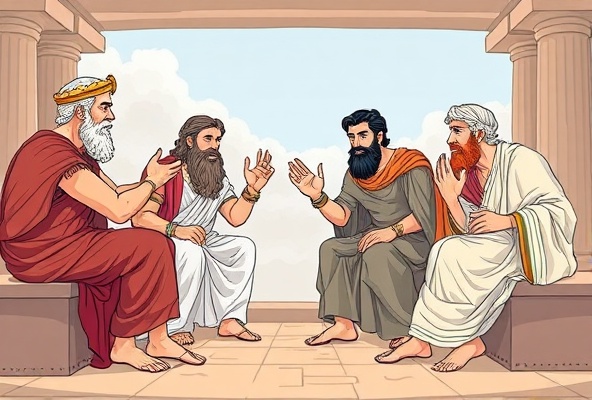
Logic is the science of reasoning and the laws of thought. The study of logic enables the mind to distinguish truth from falsehood through rational analysis and systematic thinking. Logic was formalized by Aristotle in his work on syllogistic reasoning—the method of drawing valid conclusions from established premises.
In the medieval period, logic became the primary intellectual tool for theological disputation and the reconciliation of faith and reason. Scholars like Thomas Aquinas used logical methods to demonstrate the harmony between revealed truth and rational philosophy. The study of logic became central to university education and to the development of scientific method during the Renaissance.
Logic provides the rules by which thought operates correctly. Valid argument depends upon proper logical form; otherwise, conclusions may appear true when they are actually false. The study of logic trains the mind to recognize fallacies, to construct sound arguments, and to refute errors through rational demonstration.
In Masonic teaching, Logic represents the ability to think clearly and rigorously about truth. The Mason who masters logic gains protection against deception and self-delusion. Logic is the tool by which the Mason can examine his beliefs, test his assumptions, and advance toward greater understanding. It represents the triumph of reason over prejudice and superstition.
Key Principles:
- • Laws of reasoning and valid argument
- • Syllogistic logic and deductive reasoning
- • Recognition and refutation of fallacies
- • Distinction between truth and error
- • Development of rational faculty
Historical Development
Ancient Era: Aristotle systematized logic and developed the theory of the syllogism, making it the most rigorous intellectual discipline.
Medieval Period: Logic became the primary tool for theological disputation and was refined through centuries of scholastic analysis.
Scientific Revolution: Logic formed the foundation of scientific method and empirical investigation.
Rhetoric: The Art of Persuasion and Eloquence
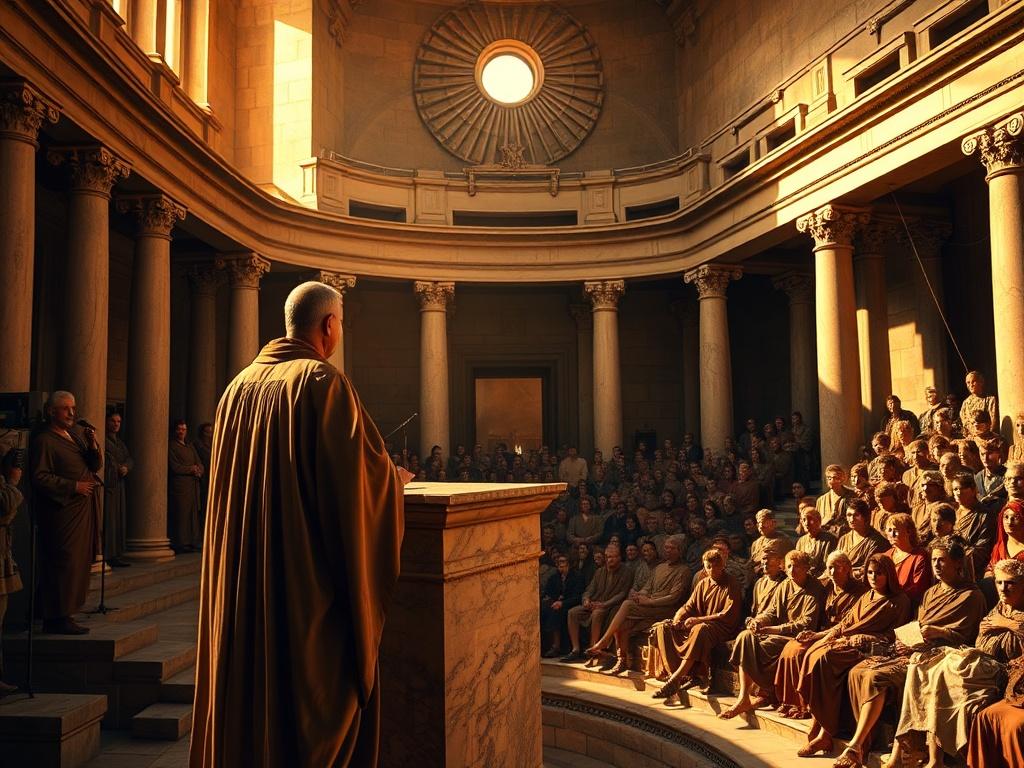
Rhetoric is the art of persuasive and eloquent speech—the ability to move hearts and minds through language. Developed extensively by the Greeks and Romans, rhetoric was considered essential to civic participation. In ancient Athens and Rome, the ability to speak persuasively was crucial for those engaged in government, law, and public affairs.
The greatest orators of antiquity—Demosthenes in Greece and Cicero in Rome—were studied for centuries as models of rhetorical excellence. Their speeches demonstrated not merely technical skill but the power of language to inspire virtue, expose falsehood, and move people to noble action. Rhetoric encompassed not just technique but also ethics and the responsible use of persuasive power.
Medieval scholars preserved and transmitted rhetorical learning, understanding that the church needed eloquent preachers who could move people toward faith and virtue. Renaissance humanists recovered classical rhetorical texts and made them central to education. They understood that rhetoric, properly used, was a tool for spreading truth and improving human society.
In Freemasonry, rhetoric represents the Mason's ability to communicate truth effectively. The power of words to move hearts and minds comes with responsibility. Rhetoric teaches that language should be used ethically and honestly, never for deception or manipulation. The Mason who masters rhetoric becomes an effective teacher, leader, and advocate for truth within the fraternity and in the world.
Key Principles:
- • Persuasive and eloquent expression
- • Moving hearts and minds toward truth
- • Ethical use of language
- • Power of words to inspire virtue
- • Responsibility of the speaker to truth
Historical Development
Ancient Era: Greek and Roman education emphasized rhetoric as essential to citizenship; Cicero's speeches became models for eloquence.
Medieval Period: The Church developed sacred rhetoric for preaching and teaching the faith to diverse populations.
Renaissance: Humanists elevated rhetoric as the art of civilized communication and human persuasion toward virtue.
The Quadrivium
The Arts of Number and Harmony—Understanding Divine Creation
Arithmetic: The Science of Number
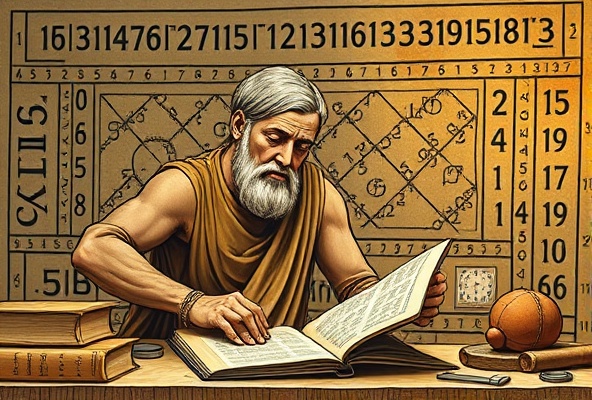
Arithmetic is the science of number and quantity. The Pythagoreans of ancient Greece developed profound insights into the nature of number, discovering that numbers possess inherent properties and relationships. They understood that number was not merely a tool for counting but a fundamental reality underlying all existence.
Pythagorean philosophers discovered numerical ratios in music (the intervals between musical notes), in geometry (the proportions of shapes), and in nature (the patterns observed in the cosmos). They taught that understanding number was the path to understanding the divine intelligence that created and maintains the universe.
Medieval scholars continued this tradition, understanding that arithmetic revealed divine truths. Numbers were seen as reflecting divine attributes—unity (God), duality (the divine and creation), trinity (the Christian doctrine), and so forth. The study of number was thus a spiritual practice as well as a mathematical one.
In Masonic philosophy, arithmetic represents the principle of unity underlying all creation. Through arithmetic, the Mason learns that all quantities are expressions of number, that all multiplicities proceed from unity, and that mathematical harmony underlies physical reality. Arithmetic teaches that diversity and unity are not opposites but manifestations of number.
Key Principles:
- • Science of numbers and quantity
- • Pythagorean understanding of number ratios
- • Foundation of all mathematical knowledge
- • Numerical symbolism in spiritual tradition
- • Unity underlying diversity
Historical Development
Ancient Era: Pythagoreans discovered deep spiritual significance in number and numerical relationships.
Medieval Period: Number symbolism played a crucial role in theological understanding and biblical interpretation.
Scientific Era: Arithmetic became the foundation for physics and engineering calculations.
Geometry: The Science of Form and Proportion
Geometry is the science of space, form, and proportion. The word "geometry" literally means "measuring the earth." The ancient Egyptians developed practical geometry for surveying land and constructing their monumental architecture. The Greeks transformed geometry into a rigorous mathematical science, with Euclid's "Elements" becoming one of the most influential mathematical texts ever written.
Greek geometers discovered the profound harmony and proportion underlying physical reality. They found that certain proportions—the golden ratio, the regular polyhedra—appeared throughout nature. The Platonic solids were understood as the fundamental forms underlying creation. Geometry was thus not merely a practical tool but a window into divine intelligence.
Medieval builders used geometry extensively in cathedral construction. The proportions of medieval cathedrals reflected geometric principles and sacred geometry—the belief that certain geometric relationships embodied divine truth. The rose windows, pointed arches, and intricate geometric patterns in medieval architecture were expressions of theological knowledge through geometric form.
For Freemasons, geometry holds special significance. The craft of stonemasonry itself depends on geometric principles. More importantly, geometry represents the divine order of creation. Through geometry, the Mason learns that the universe is not chaotic but orderly, proportioned, and beautiful—the work of a divine architect. The square and compass—the primary symbols of Freemasonry—are geometric instruments representing the sacred principles of the craft.
Key Principles:
- • Science of space, form, and proportion
- • Sacred geometry and divine proportions
- • Platonic solids and fundamental forms
- • Principles of architecture and construction
- • Divine order of creation
Historical Development
Ancient Era: Euclidean geometry became the most rigorous mathematical system; Platonic solids were considered divine forms.
Medieval Period: Geometry was essential to cathedral builders and craftsmen; sacred geometry influenced all architectural design.
Renaissance & Beyond: Geometry remained central to art, architecture, and the emerging scientific revolution.
Music: The Harmony of the Universe
Music in the classical understanding was not merely the art of making pleasant sounds. Rather, it was the science of harmony and proportion, encompassing the mathematical relationships underlying all harmonic phenomena. Pythagoras discovered that musical intervals correspond to simple mathematical ratios—the octave (2:1), the fifth (3:2), the fourth (4:3)—and realized that these same ratios appeared throughout nature.
This led to the concept of the "music of the spheres"—the idea that the celestial bodies in their motions produce harmonic relationships. The planets, in their courses around the earth (or sun), were believed to create a cosmic music—an eternal harmony that sustains the universe. While this cosmology has been superseded, the insight remains: that underlying all of reality is mathematical harmony.
Medieval theologians understood music as revealing divine order and harmony. The liturgical music of the Church was composed according to mathematical principles. The development of polyphony in the medieval period—the combining of multiple melodic lines in mathematical proportions—represented a conscious effort to create music that reflected heavenly harmony.
In Masonic teaching, music represents the harmony that permeates creation. It teaches that seemingly diverse elements—different individuals, different perspectives—can combine in beautiful harmony when guided by proper principles. Music bridges the rational and emotional, demonstrating that truth can be apprehended not only through logic but also through beauty and harmony.
Key Principles:
- • Harmony and proportion in sound
- • Mathematical ratios in musical intervals
- • Music of the spheres—cosmic harmony
- • Unity of opposites through harmony
- • Bridge between reason and emotion
Historical Development
Ancient Era: Pythagoras discovered mathematical ratios in musical intervals and conceived the music of the spheres.
Medieval Period: Plainchant and polyphony were developed according to mathematical and theological principles.
Renaissance & Beyond: Music became increasingly sophisticated while remaining grounded in harmonic principles.

Astronomy: The Study of Cosmic Order
Astronomy is the science of celestial bodies and the cosmos. For ancient civilizations, astronomy was both practical and spiritual—essential for timekeeping and agriculture, but also a window into understanding divine intelligence. The apparent perfect order and regularity of celestial motions indicated to ancient philosophers the existence of eternal principles transcending the changing terrestrial world.
Ptolemy, Copernicus, and eventually Newton transformed astronomy from naked-eye observation into a rigorous mathematical science. The discovery that planets follow elliptical orbits around the sun, subject to mathematical laws of gravitation, provided concrete evidence that the universe operated according to rational principles discoverable through human reason. Astronomy became the crown jewel of the mathematical sciences.
Medieval scholars incorporated astronomical knowledge into theological understanding. The structure of the cosmos—with earth at the center (in medieval cosmology) or in its proper place (in modern cosmology)—was understood as reflecting divine order. Astronomical knowledge was essential to calculating the date of Easter and other ecclesiastical matters.
In Masonic philosophy, astronomy represents the highest aspiration—to understand the cosmic order and humanity's place within the infinite universe. The study of astronomy inspires awe and humility. It reminds the Mason that the universe far exceeds human comprehension, yet human reason can penetrate its mysteries. Through astronomy, the Mason contemplates eternity and the eternal principles underlying creation. Astronomy teaches that just as the celestial bodies move in perfect order, so too should the Mason's life be ordered according to universal principles.
Key Principles:
- • Study of celestial bodies and cosmos
- • Divine order of the heavens
- • Mathematical laws governing nature
- • Human reason penetrating cosmic mysteries
- • Awe before infinity and eternal principles
Historical Development
Ancient Era: Astronomy was both practical and spiritual; celestial order indicated divine intelligence.
Medieval Period: Astronomical knowledge was preserved and transmitted; cosmology was integrated with theology.
Scientific Revolution: Copernicus, Kepler, and Newton transformed astronomy into rigorous mathematical science.
The Relationship Between Trivium and Quadrivium
The Trivium: Gateway to Knowledge
The Trivium—Grammar, Logic, and Rhetoric—represents the arts of communication and language. These three disciplines form the gateway through which the student must pass before ascending to the higher mathematical sciences. One cannot effectively study the Quadrivium without first mastering language, logic, and the art of expression.
Grammar provides the vocabulary and syntax—the basic tools. Logic provides the method—the principles by which thought operates correctly. Rhetoric provides the power—the ability to communicate understanding effectively. Together, the Trivium develops clear thinking, sound reasoning, and effective communication.
The Quadrivium: Understanding Creation
The Quadrivium—Arithmetic, Geometry, Music, and Astronomy—represents the mathematical sciences. These four disciplines reveal the quantitative and harmonic principles underlying creation. Where the Trivium is concerned with language and thought, the Quadrivium is concerned with number and form.
Arithmetic reveals the nature of number itself. Geometry reveals the principles of form and proportion. Music reveals harmony and proportion as expressed in sound and vibration. Astronomy reveals these principles as manifest in the vast cosmos. Together, the Quadrivium grants understanding of creation's mathematical structure.
The Complete Path of Knowledge
The progression from Trivium to Quadrivium reflects the natural order of learning and spiritual development. The Trivium trains the faculty of thought and communication. The Quadrivium reveals the principles by which reality itself is constituted. Together, they create a complete education in the disciplines that matter most—those that develop mind and spirit and enable comprehension of both human wisdom and divine creation.
In medieval understanding, this educational progression also reflected spiritual ascent. The mastery of language and reason (Trivium) enables the soul to purify itself of ignorance and confusion. Comprehension of the mathematical and harmonic principles of creation (Quadrivium) enables the soul to contemplate eternal truths and approach nearer to understanding divine intelligence.
In Freemasonry, the study of these arts is integral to the Mason's journey. The Seven Liberal Arts represent the complete education of the mind and development of the spirit. A Mason who has studied these disciplines thoroughly has gained the tools to think clearly, communicate effectively, understand the principles underlying creation, and contemplate the infinite order and beauty of the universe. These are the tools of enlightenment and the foundations of wisdom.
The Seven Liberal Arts in Modern Masonic Practice
Practical Application in Lodge Life
While Freemasonry originated in the practical craft of stonemasonry, modern Masonry is primarily concerned with the symbolic and spiritual significance of the craft. The Seven Liberal Arts remain central to Masonic education and symbolism. The study of these arts, formally and informally, is encouraged throughout a Mason's progression through the degrees.
Personal Development and Enlightenment
The study of the Seven Liberal Arts remains one of the most effective methods for personal development and spiritual growth. For the contemporary Mason, these disciplines offer guidance for cultivating clear thinking, sound judgment, effective communication, and understanding of the principles that govern both human society and the natural world. The pursuit of knowledge in these disciplines is itself a Masonic pursuit, reflecting the fraternity's commitment to enlightenment and self-improvement.
The Eternal Value of the Liberal Arts
Though the specific content of these disciplines evolves as knowledge advances, the Seven Liberal Arts retain their fundamental significance. They represent the core disciplines that have enabled human civilization to develop, preserve knowledge, and progress toward enlightenment. In an age of specialization and fragmentation of knowledge, the Seven Liberal Arts remind us of the unity underlying all knowledge and the importance of developing a broad, liberal education.
For Freemasons, the Seven Liberal Arts represent the Fraternity's highest ideals: the pursuit of truth through reason and learning, the development of clear and virtuous communication, and the contemplation of the divine principles that order and sustain the universe. To study these disciplines is to participate in the great conversation of Western civilization, to align oneself with the greatest thinkers and builders of the past, and to contribute to human knowledge and enlightenment.