Rhetoric: The Art of Persuasion and Expression
Rhetoric, the third and crowning art of the Trivium, is the discipline of eloquent and persuasive speech. It teaches the orator to move the hearts and minds of listeners, to present truth in the most compelling manner, and to exercise the power of language in service of worthy ends. In classical tradition, rhetoric was the culmination of liberal education, preparing the citizen for participation in public life and governance.
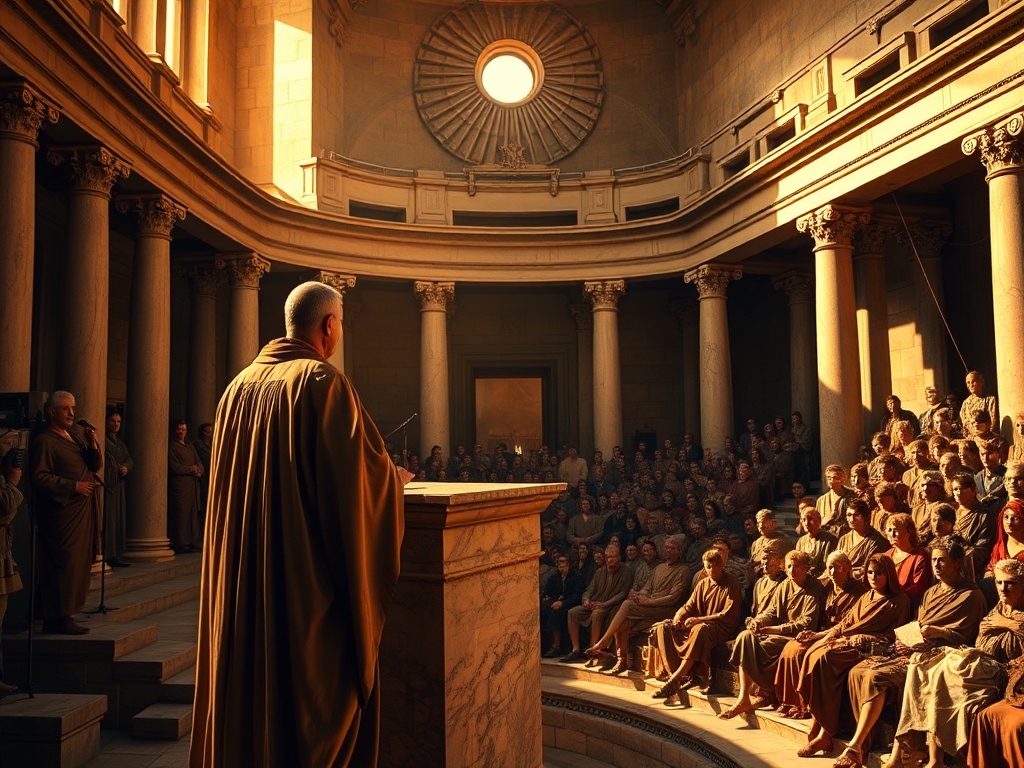
The Art of Persuasion
Rhetoric is defined as the art of persuasion, or more precisely, the ability to discover the available means of persuasion in any given situation. Aristotle defined it as "the faculty of observing in any given case the available means of persuasion." This definition emphasizes that rhetoric is not merely ornamental or deceptive speech, but a practical art concerned with identifying what will genuinely move and convince an audience.
The Roman orator Cicero elevated rhetoric to supreme importance in the education of the citizen. He defined the ideal orator as "a wise man speaking." This formulation united eloquence with wisdom and virtue—the orator must not only speak beautifully, but must speak truthfully and in service of the good. Without wisdom, rhetoric becomes mere sophistry; the true orator uses his powers of persuasion in service of truth and justice.
The study of rhetoric encompasses the discovery of arguments (invention), their arrangement in persuasive form (disposition), the expression of these arguments in beautiful language (style), the memorization of speeches, and their effective delivery. Each of these components contributes to the orator's ability to move and convince his audience.
The Birth of Rhetoric in Ancient Greece
Rhetoric emerged as a formal discipline in ancient Greece, particularly in Syracuse, where it was developed to teach citizens the arts of persuasion in democratic assemblies and law courts. The development of democracy required citizens to persuade their peers through eloquent speech rather than through force or authority.
The earliest Greek rhetoric teachers, known as Sophists, were sometimes criticized for teaching persuasion without regard for truth. But greater thinkers like Plato and Aristotle, while critical of sophistry, recognized rhetoric as a legitimate and important discipline when united with philosophical truth. Aristotle's systematization of rhetoric became the foundation for all subsequent study of the art.
Greek orators like Demosthenes and Aeschines demonstrated the power of rhetoric in actual political and legal contests. Their speeches, preserved in texts, became models for the study of rhetoric. The Greek appreciation for logos (both reason and eloquent speech) placed the orator at the center of civic and cultural life.
Roman Excellence in Oratory
The Romans elevated rhetoric to supreme importance in education and public life. Roman orators, unlike Greek ones, faced the challenge of speaking in Latin, a language they had to master as completely as the Greeks mastered their own language. The greatest Roman orators, particularly Cicero, set standards for eloquence that would be studied and imitated for centuries.
Cicero's rhetorical works, including the "De Oratore" and "Brutus," provided comprehensive accounts of rhetoric and of the great orators of Greece and Rome. His own speeches—his orations against Mark Antony known as the Philippics being the most famous—demonstrated rhetoric at its most powerful. Cicero combined logical argument, emotional appeal, and magnificent language in service of profound conviction.
Roman rhetoric training was highly formalized, with specific exercises designed to develop the student's abilities. The young Roman intended for a public career would be trained in rhetoric to prepare him for military command, participation in the Senate, and leadership roles. Rhetoric was understood as central to the education required for leadership in a civilized society.
The Elements and Modes of Rhetoric
The Three Appeals
Aristotle identified three modes of persuasion: ethos (the credibility and character of the speaker), pathos (the emotions and values of the audience), and logos (logical argument and proof). The effective orator employs all three: establishing his own credibility, moving the hearts of the audience through emotional appeal, and presenting sound logical arguments.
The Three Branches of Oratory
Judicial rhetoric concerned itself with courtroom speeches, defending or accusing in legal proceedings. Deliberative rhetoric addressed political assemblies, persuading citizens regarding matters of public policy. Epideictic or ceremonial rhetoric praised or blamed, celebrating the good and condemning the evil, often used on solemn public occasions.
Style, Arrangement, and Delivery
The orator must arrange his arguments in an effective order, use language appropriate to his subject and audience, employ figures of speech and other stylistic devices, and deliver his speech with proper emphasis, tone, and gesture. Each element contributes to the overall persuasive impact.
Rhetoric in Masonic Practice
In Freemasonry, rhetoric holds special significance as the art through which Masonic truth is communicated. The Worshipful Master, the orators of the lodge, and all who speak in the lodge room engage in a form of rhetoric. The Masonic lectures are rhetorical works of high order, designed to instruct, inspire, and move the Masons who hear them.
Masonic rhetoric differs from forensic or political rhetoric in that it aims not at momentary persuasion, but at genuine enlightenment and spiritual development. The Masonic orator employs all the arts of rhetoric—logical argument, emotional appeal, beautiful language—but always in service of truth and the elevation of the Mason's understanding.
Furthermore, the study of rhetoric trains the Mason in the responsible use of language. The powers of eloquence can be used for good or ill; the Mason is bound by his obligations to use his powers of persuasion ethically and in service of justice. This union of rhetoric with virtue reflects the classical ideal of "the wise man speaking."
Rhetoric in the Modern Age
In an age of mass communication, the study of rhetoric becomes ever more critical. Understanding how language persuades, how images and language combine to move people, how to recognize and resist manipulation—these are essential skills in the modern world. The Mason who studies rhetoric gains tools to navigate contemporary communication environments wisely.
The contemporary study of rhetoric can be pursued through the classical texts—reading and analyzing the speeches of Cicero and Demosthenes, studying Aristotle's "Rhetoric," understanding the principles that have governed persuasive communication for twenty-five centuries. Or it can involve analyzing contemporary rhetoric, examining how modern speakers, writers, and advertisers employ the techniques of persuasion.
For the Mason, the study of rhetoric completes the Trivium of language studies. Having mastered grammar and logic, the Mason studies rhetoric to understand the full power and responsibility of eloquent speech. The goal is not mere eloquence, but eloquence in service of truth and human flourishing—the ideal of the wise person speaking well.