Music: The Science of Harmony
Music, the third mathematical science of the Quadrivium, is the study of harmony, proportion, and rhythm. It encompasses both the practical art of musical composition and performance, and the theoretical understanding of how sounds relate to each other according to mathematical principles. In classical and Masonic tradition, music is understood as revealing the harmonic principles that order both the physical universe and the human soul.
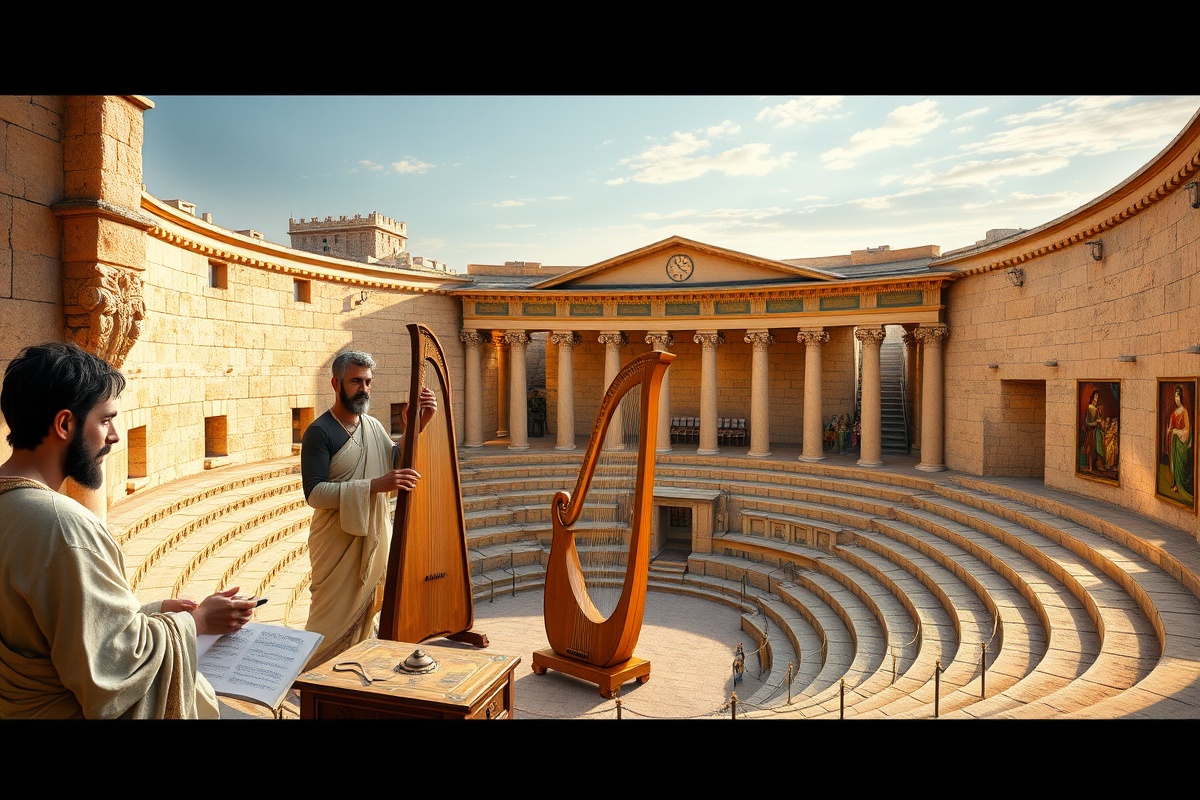
Harmony and Mathematical Proportion
Music in classical understanding is not merely the art of composition and performance, but the science of harmony—the study of how sounds relate to each other according to mathematical proportions. Boethius defined music as "the discipline of the harmonious relationship between sounds," reflecting the understanding that what makes music beautiful is the proportion and harmony between its elements.
The Greeks discovered that the intervals between musical notes could be expressed as mathematical ratios. The most fundamental and consonant interval, the octave, is the ratio 2:1—when one note has twice the frequency of another, we perceive them as the same note at different pitches. The fifth, another fundamental interval, has the ratio 3:2. These ratios are simple, elegant, and reflect mathematical principles.
This discovery that musical harmony is based on mathematical proportion raised profound questions: Why should mathematical ratios produce beautiful sounds? What does this reveal about the nature of reality? The answer, for classical thinkers, was that the same mathematical principles that order the physical universe—the proportions and harmonies of creation—are expressed in music.
Pythagoras and the Music of the Spheres
Pythagoras is credited with discovering the mathematical ratios underlying musical intervals. According to legend, he heard blacksmiths striking anvils with different weights and recognized that the consonant intervals produced corresponded to simple mathematical ratios. He experimented with a stringed instrument called the monochord, confirming that shortening a string by precise fractions produced harmonious intervals.
Pythagoras and his followers developed the concept of the "music of the spheres"—the idea that the celestial bodies, in their orbital motion, produce a form of music. Although we cannot hear this music with our ears, the proportions that govern the cosmos are musical proportions. The harmony of creation expresses itself in both audible music and the silent harmony of the heavens.
This vision of cosmic harmony deeply influenced subsequent philosophy and theology. If the universe is fundamentally harmonious, then harmony is not merely an aesthetic quality but an expression of cosmic order. Music becomes a path to understanding the principles that govern reality at the deepest level.
Music in Medieval and Renaissance Understanding
Medieval theologians integrated the Pythagorean understanding of musical harmony with Christian theology. They recognized that the cosmos was harmoniously ordered by divine wisdom. Musical harmony was understood as a reflection of divine order. The Gregorian chant, with its austere beauty, was considered to be spiritually uplifting because its harmony reflected divine order.
Medieval musicians developed increasingly sophisticated polyphonic music—multiple melodic lines sounding together in harmonious relationship. The development of written notation enabled the composition and preservation of complex musical structures. The mathematics of harmony, expressed through the ratios of musical intervals, governed the composition of medieval sacred music.
Renaissance composers continued this tradition while also embracing increasingly emotional and expressive music. The development of harmony as we understand it today—with chords and progressions—emerged during this period. Yet the underlying principle remained: music is fundamentally a matter of proportion and harmony, expressing eternal principles through sound.
The Mathematical Basis of Musical Intervals
The Octave and Perfect Intervals
The octave (2:1) is the most fundamental interval. When a note vibrates at twice the frequency of another, they sound like the same note at different pitches. The perfect fifth (3:2) and perfect fourth (4:3) are the most consonant intervals after the octave. These three intervals form the foundation of all musical harmony.
Consonance and Dissonance
Intervals based on simple ratios sound consonant and pleasant. The major third (5:4) and minor third (6:5) are consonant intervals. As ratios become more complex, intervals sound increasingly dissonant until they require resolution to consonant intervals. This principle governs harmony and the sense of musical tension and release.
Tuning Systems and the Harmonic Series
Different tuning systems place musical notes at different frequencies. Just intonation bases all intervals on simple ratios from the harmonic series. Equal temperament, the standard modern tuning, divides the octave into twelve equal steps, allowing music in all keys. Each system represents a different approach to expressing musical harmony mathematically.
Music in Masonic Tradition
In Masonic tradition, music is understood as one of the principal sciences through which cosmic order is perceived and expressed. The harmony that characterizes well-conducted Masonic work—where all members function in proper relationship—is understood as reflecting the harmony of creation itself. The Masonic lodge, properly governed, achieves a kind of harmony analogous to musical harmony.
The study of music teaches the Mason that apparent diversity—different notes sounding together—can create beautiful harmony through proper proportion and relationship. This principle applies to the Masonic fellowship: individual brethren, diverse in background and perspective, unite in harmonious work for common purposes. The harmony of the lodge reflects the same principles that govern musical harmony.
Furthermore, music is understood in Masonic teaching as a path to spiritual elevation. Beautiful music moves the soul, opens the heart, and creates states of consciousness aligned with higher truths. The study of music's mathematical foundations combined with experience of music's emotional power demonstrates the unity of reason and feeling, mind and heart.
Music in Contemporary Perspective
The contemporary study of music can encompass the mathematical foundations—the harmonic series, tuning systems, and the physics of sound. Or it can involve the study of music history, analyzing how different cultures and periods have expressed their understanding of harmony. Or it can involve practical music-making: composition, performance, or listening with understanding.
Modern physics has revealed that the entire universe is fundamentally vibrational—particles and energy express themselves through oscillations and waves. This contemporary understanding echoes the ancient Pythagorean vision: reality, at its deepest level, is vibrational and proportional, mathematical and harmonic.
For the Mason, the study of music represents understanding that beauty, order, and truth are not separate from mathematics and proportion, but expressions of eternal principles. The pursuit of musical understanding—whether theoretical or practical—is a path toward perceiving and aligning oneself with the harmonic principles that order creation.