Geometry: The Science of Space and Form
Geometry, the second mathematical science of the Quadrivium, is the study of space, form, and proportion. It teaches the principles governing shapes, their relationships, and their transformations. In classical and Masonic tradition, geometry is understood as revealing the divine principles of proportion and harmony that underlie all creation—making it the most essential science for those engaged in building and creation.
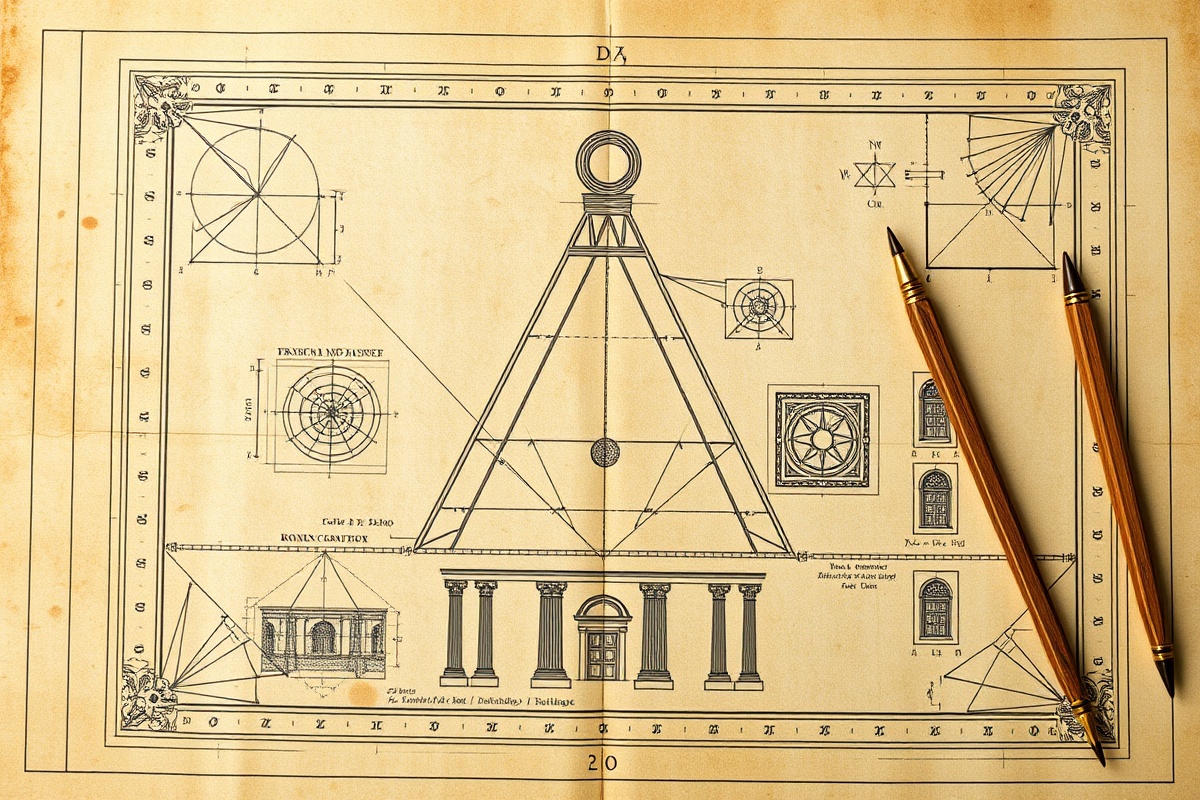
The Science of Continuous Quantity
Geometry is classically defined as the science of continuous quantity—the study of magnitudes and their relationships. While arithmetic deals with discrete units (whole numbers), geometry deals with continuous space and the forms that occupy it. The word itself comes from Greek, meaning "earth measurement," though geometry as a pure science concerns itself with abstract spatial relationships rather than practical surveying.
Euclid, in his great work "Elements" (c. 300 BCE), systematized geometry as a deductive science built on fundamental axioms and definitions. Starting from basic definitions (point, line, plane) and self-evident truths, Euclid demonstrated how all of geometry could be logically derived. Euclid's approach made geometry the model of rigorous intellectual thought for over two thousand years.
In classical understanding, geometry revealed the harmony and proportion underlying creation. The regular solids—the tetrahedron, cube, octahedron, dodecahedron, and icosahedron—were understood as expressing fundamental principles of cosmic structure. The discovery that these five forms were the only possible regular polyhedra seemed to reveal a profound truth about the nature of reality.
The Origins and Development of Geometry
Geometry emerged from practical necessity—the need to measure land, build structures, and navigate. The ancient Egyptians developed geometrical knowledge for constructing their great monuments. The Thales of Miletus (c. 600 BCE) is traditionally credited with being the first to prove geometric theorems rather than merely applying geometric knowledge to practical problems. This shift from practical application to theoretical understanding marked the birth of geometry as a mathematical science.
Pythagoras and his followers made geometry central to their understanding of reality. They discovered the Pythagorean theorem, demonstrating that mathematical relationships could be expressed through geometric forms. The golden ratio—an irrational proportion that appears throughout nature—became central to classical aesthetics and architecture.
Plato emphasized geometry's importance for understanding reality. The famous inscription above Plato's Academy read, "Let none ignorant of geometry enter." For Plato, geometry was the path from the visible, changing world to the invisible, eternal realm of forms. Geometric thinking trained the mind to perceive eternal truths.
The Golden Ratio and Sacred Proportion
The golden ratio, represented by the Greek letter phi (φ), appears repeatedly in nature, art, and architecture. When a line is divided so that the ratio of the whole to the larger segment equals the ratio of the larger segment to the smaller segment, the result is the golden ratio. This proportion appears in the spiral of a nautilus shell, in the arrangement of seeds in a sunflower, in the proportions of the human body.
Ancient Greek architects incorporated the golden ratio into their temples, believing it expressed divine proportion. The Pentagon, with its golden ratios, held special significance in Pythagorean and other mystical traditions. Renaissance artists, rediscovering the golden ratio, used it to create compositions of extraordinary beauty and balance.
For those who study geometry deeply, the golden ratio is not mere mathematical curiosity but an expression of divine wisdom. The fact that this proportion appears throughout creation suggests that it expresses a fundamental principle of beauty, harmony, and proper relationship. Understanding and applying these proportions is central to creating works of lasting beauty.
Euclidean and Non-Euclidean Geometry
Euclid's geometry, based on his axioms and postulates, dominated Western mathematics for two thousand years. The elegance of Euclidean geometry, the certainty of its proofs, made it seem like the ultimate expression of geometric truth. However, in the 19th century, mathematicians discovered that alternative geometries were possible—geometries based on different axioms that were just as logically rigorous as Euclidean geometry but described different spatial properties.
These non-Euclidean geometries initially seemed like abstract curiosities, but they proved essential to Einstein's general relativity, which describes how space is curved near massive objects. This development shows that even ancient, seemingly eternal truths can be transcended and understood within larger frameworks.
For the Mason studying geometry, both Euclidean and non-Euclidean geometries offer profound lessons. Euclidean geometry reveals the principles of proportion and harmony that underlie the visible world. Non-Euclidean geometry demonstrates that reality may be more complex and mysterious than it first appears, and that human understanding must always remain open to new discoveries.
Geometry in Architecture and the Building Arts
Geometry is the science most directly relevant to the craft of stonemasonry and building. The medieval stonemasons who built the great cathedrals possessed sophisticated geometric knowledge. The proportions of their structures, the patterns of their vaults and arches, the relationships between the various elements—all embodied geometric principles.
Medieval cathedral builders worked with geometric proportions, often using a method of geometric construction known as "dynamic rectangles." A square could be generated from a rectangle, or vice versa, through compass and straightedge construction. These methods enabled builders to create structures of extraordinary harmonic beauty.
The fact that Freemasonry traces its origins to medieval stonemasons means that geometry holds special significance in Masonic tradition. The tools of the Mason—the square, the compass, the plumb line—are instruments of geometric understanding and precise measurement. Through geometry, the Mason brings divine proportion and harmony into material form.
Geometry in Masonic Tradition
In Masonic symbolism, geometry holds supreme importance. The square and compass—the fundamental tools of geometry—are the principal symbols of Freemasonry. The square represents what is bounded and orderly; the compass represents what is unlimited and free. Together, they represent the balance between constraint and freedom, between order and possibility.
Masonic teachings emphasize that "Geometry is the Universal Language." Through geometric forms and proportions, the Mason perceives the universal principles underlying creation. The study of geometry enables the Mason to understand divine wisdom expressed through proportion, harmony, and relationship.
The progression in Freemasonry—from the operative craft that builds physical structures to the speculative craft that builds spiritual and intellectual understanding—reflects the progression from practical geometry to theoretical geometry. The Mason who understands that his square and compass have symbolic meaning, that the proportions he works with express eternal principles, has advanced from craft to wisdom.
Geometry in Contemporary Understanding
The contemporary study of geometry can follow multiple paths. The Mason might study classical Euclidean geometry through Euclid's "Elements," rediscovering the timeless beauty of geometric proof. Or he might explore the golden ratio and sacred proportions as they appear in art, architecture, and nature. Or he might engage with modern mathematics, including topology, fractals, and other geometries that reveal new dimensions of spatial understanding.
Increasingly, geometry is understood through visualization and computer graphics, revealing geometric forms and relationships that could never be fully apprehended through traditional methods. The Mandelbrot set and other fractals reveal infinite complexity within geometric forms, demonstrating that the simplest geometric principles can generate breathtaking complexity.
For the Mason, the study of geometry is ultimately about perceiving divine wisdom expressed through form and proportion. Whether through classical Euclidean geometry or contemporary mathematical forms, the goal is the same: to understand the harmonious order underlying creation and to participate in the eternal principles that govern beauty, proportion, and harmony.