Arithmetic: The Science of Number
Arithmetic, the first of the four mathematical sciences that constitute the Quadrivium, is the study of number itself. It teaches the properties of numbers, their relationships, and the laws governing numerical operations. In classical and Masonic tradition, arithmetic is understood as revealing the numerical patterns that underlie all creation—the fundamental mathematical order that governs both the physical universe and spiritual reality.
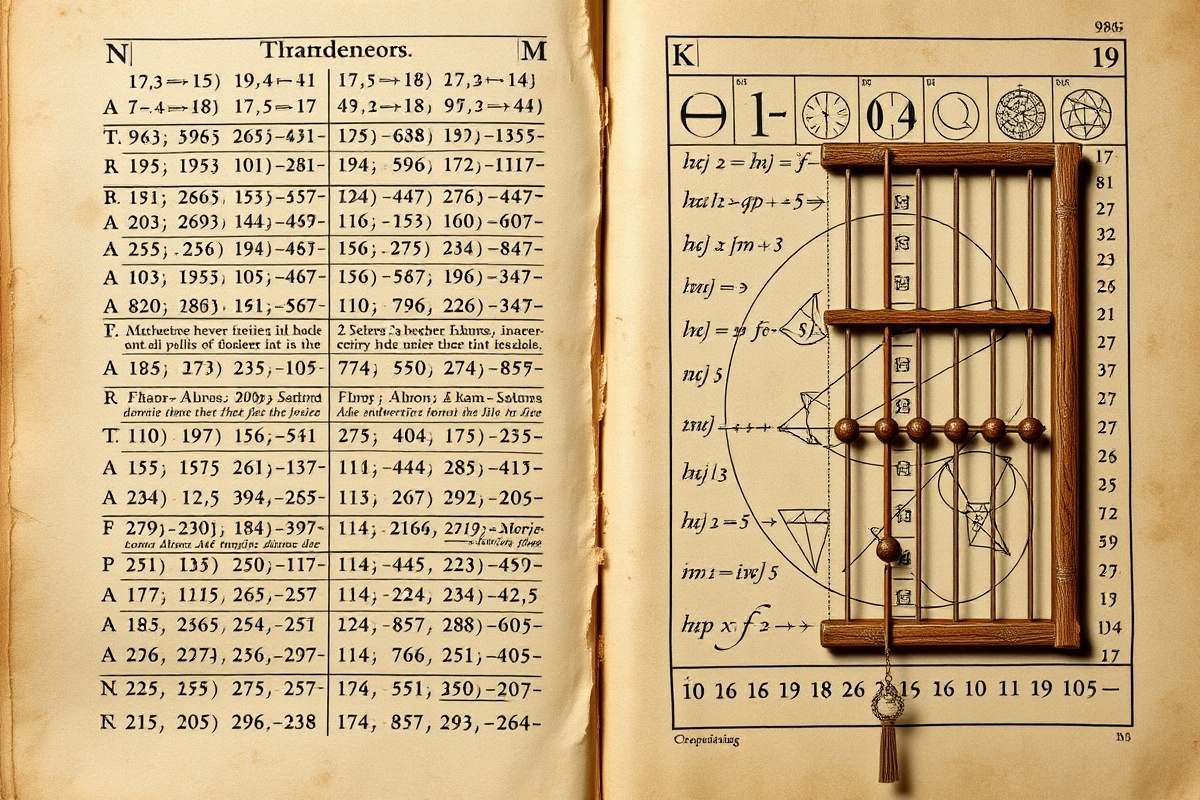
The Science of Discrete Quantity
Arithmetic is classically defined as the science of discrete quantity—the study of numbers taken individually and in their relationships. It is distinguished from geometry, which deals with continuous quantity. In classical thought, arithmetic was understood as studying the abstract properties of number itself, rather than the application of number to practical counting or commerce.
The Pythagorean philosophers of ancient Greece placed arithmetic at the foundation of all knowledge. They recognized that numbers possess remarkable properties and that numerical relationships appear throughout nature. The Pythagoreans believed that "all things are numbers"—that the fundamental reality underlying the physical world is numerical and mathematical.
Boethius, the medieval systematizer of the liberal arts, defined arithmetic as "the discipline treating of multitude in itself." This definition emphasizes that arithmetic studies the abstract properties of number, not numbers as applied to concrete things. The study of arithmetic reveals the eternal forms and principles underlying quantitative reality.
Pythagoras and the Science of Number
Pythagoras (c. 570-495 BCE) and his philosophical school made arithmetic the centerpiece of their understanding of reality. The Pythagoreans studied the properties of numbers, discovering that certain numbers possessed special significance. They classified numbers as even and odd, as prime and composite, and identified perfect numbers—numbers equal to the sum of their proper divisors.
Most famously, the Pythagoreans discovered the Pythagorean theorem—the relationship between the sides of a right triangle. This discovery revealed that mathematical relationships could be expressed through whole numbers and that the structure of physical space itself was fundamentally mathematical. This discovery profoundly influenced subsequent mathematics and philosophy.
The Pythagorean discovery of irrational numbers—numbers that cannot be expressed as the ratio of whole numbers—paradoxically revealed the limits of number itself. Yet this discovery, far from diminishing the importance of arithmetic, demonstrated the profound depths of mathematical reality.
Symbolic and Mystical Properties of Numbers
The Unity and the Dyad
One represents the principle of unity, the unmanifest divine source from which all things emanate. Two, the dyad, represents the principle of division and differentiation, through which the one becomes many. Together, they represent the fundamental creative principle: unity differentiating itself to create multiplicity.
The Tetrad and Perfect Forms
Four was considered the most perfect number by the Pythagoreans, as it could be constructed as a triangle of one, two, three, and four—the tetraktys. Pythagoreans swore sacred oaths by the tetraktys. The number four appears throughout creation: four cardinal directions, four seasons, four elements in ancient cosmology.
The Decad and Perfection
Ten, the sum of one through four, was understood as the number of perfection and completion. All numbers could be understood as variations and combinations of the first ten. The tetraktys, when fully developed, totals ten, representing the entire cosmos in miniature.
Arithmetic in Medieval and Renaissance Thought
Medieval theologians and philosophers integrated the Pythagorean understanding of number with Christian theology. They recognized number as a manifestation of divine wisdom—that God, in creating the world, ordered all things according to number, measure, and weight. The mathematical structure of creation testified to the intelligence and purpose of the Creator.
Medieval cathedrals were constructed according to precise mathematical proportions. The sacred geometry embodied in these structures reflected both practical architectural knowledge and mystical understanding of numbers and their relationships. The study of arithmetic became a path to understanding divine wisdom expressed through creation.
Renaissance mathematicians advanced the science of arithmetic, developing new notations and methods for calculation. The Hindu-Arabic numeral system, transmitted through the Islamic world, gradually replaced Roman numerals, enabling more sophisticated mathematical work. By the time of the scientific revolution, arithmetic had become the foundation for the new mathematical physics.
Arithmetic in Masonic Teaching
In Freemasonry, the study of arithmetic represents the Mason's entry into the Quadrivium—the realm of mathematical and cosmic principles. After mastering the arts of language (Trivium), the Mason advances to the study of number, geometry, music, and astronomy. This progression mirrors spiritual development: from the ability to think and communicate clearly, to the contemplation of the mathematical and harmonious principles underlying all existence.
Masonic symbolism is rich with numerical significance. The numbers three, four, five, seven, and others appear repeatedly in Masonic degrees and teachings. These numbers are not arbitrary; they reflect the Pythagorean understanding that numbers possess profound spiritual and cosmological significance. By studying arithmetic, the Mason learns to read the symbolic language of Masonry.
Moreover, arithmetic teaches the Mason that underlying the apparent diversity of creation is a fundamental order and harmony. Everything can be understood in terms of number and proportion. This understanding contributes to the Mason's vision of a universe governed by divine wisdom and mathematical precision.
Arithmetic and Mathematical Knowledge Today
The modern Mason studying arithmetic can begin with the classical foundations—the Pythagorean understanding of number, the properties of numbers explored by ancient mathematicians. Understanding number not merely as a tool for counting or calculation, but as the manifestation of universal principles, opens new depths of understanding.
Modern mathematics, including number theory, abstract algebra, and higher mathematics, continues the ancient tradition of exploring the properties and relationships of numbers. The contemporary Mason might engage with modern number theory or the applications of mathematics to understanding the physical universe. The goal remains the same: to perceive the mathematical order underlying creation.
The study of arithmetic, in its deepest sense, is the study of cosmic order. Numbers are not merely human inventions; they express the eternal principles through which the universe is constituted. For the Mason, the study of arithmetic is a path to perceiving and participating in the divine order that governs all existence.